
Morgan the Faery
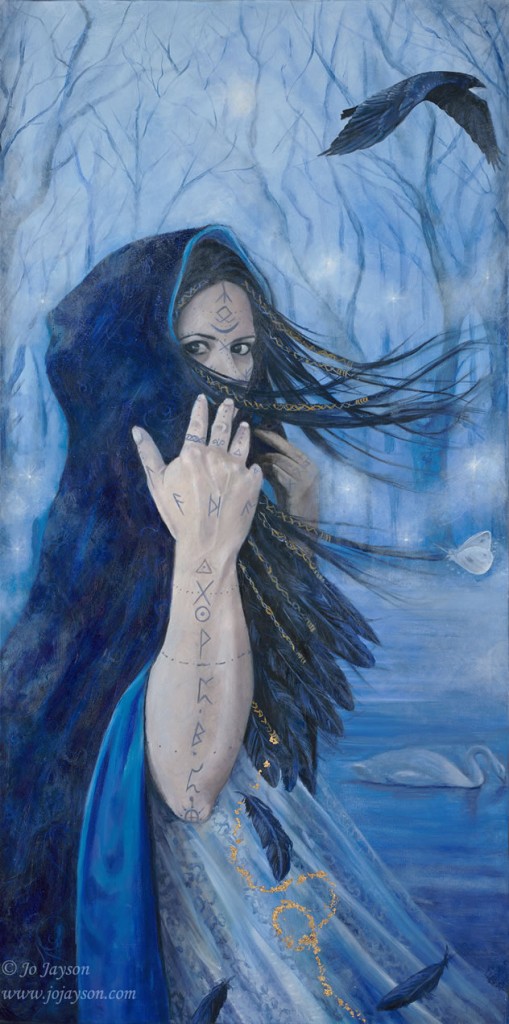 Morgan the Faery – SOLD
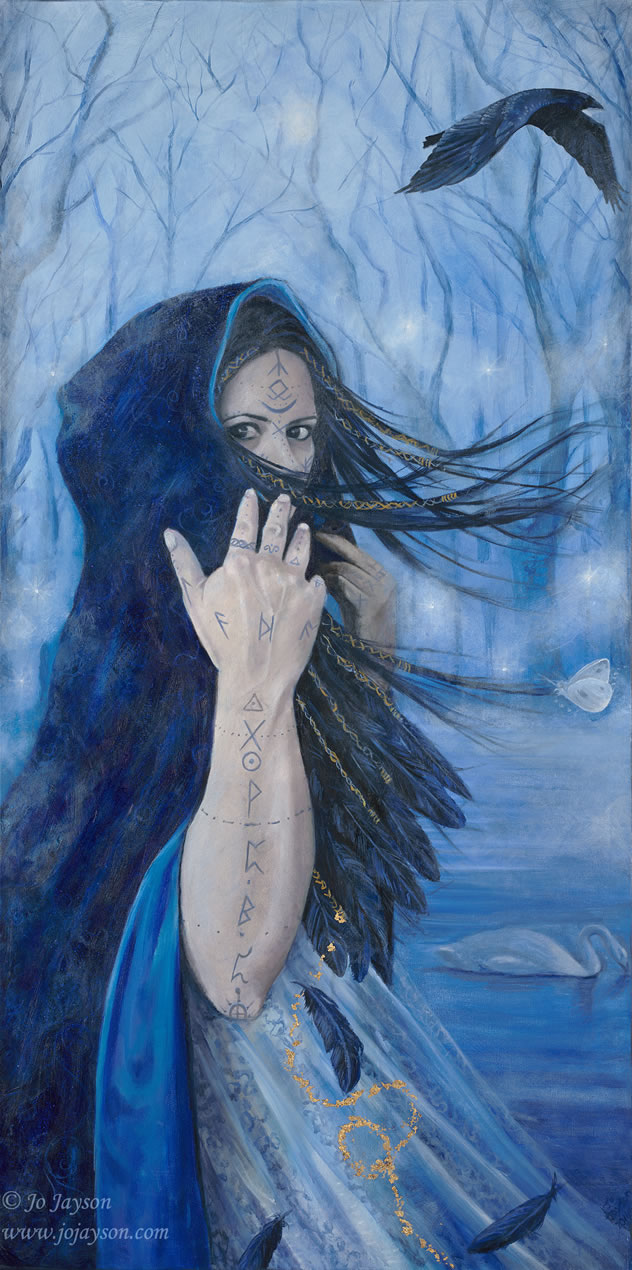
oil and gold leaf on canvas 24″x 48″ © Jo Jayson 2014
(click on image for larger version)
Reproductions, prints and more available in shop
Morgan le fay, Morgana, Morgaine, Morganis and Modron. A figure of so much mystery, confusion and misrepresentation, Morgan has become such a deep and complex character that unraveling the truth of who she was and where she originated , has become a complicated pursuit. A key figure in the Arthurian legends ,her origins come from the pagan and druid celtic culture at the time of the 5th Century. There was pagan belief that there was a sisterhood of 9 , called the Morgens, or the welsh/Breton names Mari-Morgans, meaning “water spirits”.
These water spirits inhabited the mystical misty marshlands outside of Glastonbury, in which the pagan belief was that moving through these mysterious misty lakes, would take you to the magical and healing Isle of Apples – or in translation, what we know as Avalon – the Otherworld.
This Morgan, was a healer, a shape shifter , a faery spirit that brought healing and prophesy to those that called upon her. Almost 700 years later, as the church and Christianity took a hold of pagan Briton, new literature was written about these mysterious and compelling stories of King Arthur and the various characters associated with him. Authors such as Monmouth, De Troyes, Malory and others each had their own version of this legend, each twisting and changing the stories to such a degree that they sometimes left little resemblance to the original source.
Morgan has been depicted and expressed as a high priestess of Avalon, learning her skill of magic from Merlin, or in another version whilst she was a child in a convent. As Christianity influenced people’s beliefs, Morgan’s magical and healing abilities were later expressed as dark sorcery, witchcraft, and evil. In some literature she is written as the nemesis of Arthur and Guinevere , jealous victim of unrequited love of Lancelot, mother of Mordred whom she bore with her half brother Arthur, and who later brought down the kingdom of Camelot. A myriad of versions of these stories are available, each contradicting the other.
She also is wrongly confused with Morrigan, the Irish Celtic Goddess of war and death. It is believed the church were the ones to merge this Irish dark energy together with Morgan’s Welsh archetype, hence reinforcing the belief that magic, healing, and mystery was evil and work of the devil. Celtic scholars are now clear that these two female archetypes are not connected, even though they have the symbolism of the Raven in common.. However Morgan’s association with the Raven, can be seen in its more truthful source as the ability to shape shift, to hold mystical wisdom and to connect to the otherworld beyond the veil.
The many versions of Morgan bring to our attention the play of light and dark, of good and evil, of healing and destruction, and in this paradox that she has become, we must remember her origins, a gentle but illusive water spirit of the mystery and an elemental of natural world, a Goddess, a Priestess of the highest honor, in a pagan/druid land that revered the balance of the God/Goddess of Nature.© Jo Jayson 2014

